Swisstrax Flooring vs. Epoxy Coating: Which Is Right for You?
Rick Santos • June 20, 2025
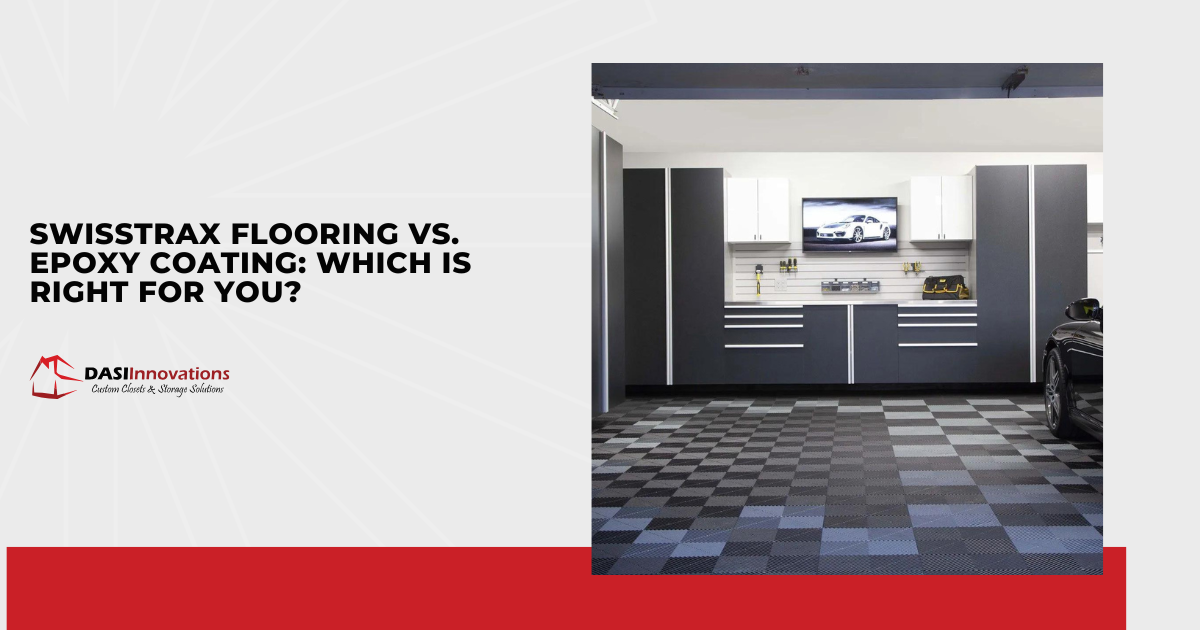
The honest answer for most Florida garages is Swisstrax interlocking tile, mainly because it goes down in a day with no fumes or curing, shrugs off heat and humidity, and lets you swap a single damaged tile instead of recoating the whole floor. Epoxy still earns its place when you want a seamless, ultra-smooth, high-gloss surface and your slab is dry and in good shape. Which one fits comes down to how you use the space and what your concrete is doing underneath.
We're DASI, and we've spent 15+ years designing and installing garage systems across Tampa Bay, building floors with Swisstrax tile. So yes, we have a point of view. We're also going to be straight with you about where epoxy makes sense and where it struggles, because a comparison is only useful if it's honest. Here's how the two stack up across the things that actually decide it: durability, maintenance, installation, cost, looks, and how each one holds up on a hot, humid Florida slab.
Swisstrax vs. Epoxy at a Glance
If you only have a minute, this is the short version. Both are a massive upgrade over bare concrete. They just get you there in very different ways.
| Factor | Swisstrax Tile | Epoxy Coating |
|---|---|---|
| Installation | One day, snap-together, no curing | Multiple days including prep and cure |
| Downtime | Walk and park on it the same day | Days before you can park on it |
| Durability | Flexes under load, resists chips and cracks | Hard and seamless, can chip and scrape |
| Repairs | Swap a single tile | Patch, sand, and recoat a section |
| Moisture tolerance | Sits above the slab, forgiving of a damp floor | Needs a dry, properly prepped slab to bond |
| Customization | Colors, patterns, textures, logos | Solid colors, metallic flake, high gloss |
| Lifespan | Long-lasting and relocatable if you move | Typically recoat every several years |
Key takeaways:
- Choose Swisstrax for fast installation, easy repairs, custom design, and tolerance for a less-than-perfect slab.
- Choose epoxy for a seamless, glossy, mop-smooth surface on a dry, well-prepped floor.
- On a typical Florida slab, moisture and heat tip the decision toward tile more often than not.
How Durable Is Swisstrax vs. Epoxy?
Both hold up to daily garage abuse, but they fail in different ways, and that difference matters more than raw strength numbers.
Swisstrax tiles are engineered to handle serious rollover weight from vehicles, and the tiles flex slightly under pressure rather than staying rigid. That flex is the whole point: instead of a hard surface that can chip or crack when a jack stand slips or a wrench drops, the tile gives a little and bounces back. Because each tile is its own unit, a rare bit of damage stays contained to that tile instead of spreading.
Epoxy is genuinely tough once it cures, seamless, and resistant to everyday abrasion. Its weak spots are impact and heat. We've seen epoxy chip from a dropped tool, scrape under a poorly placed jack stand, and dull where hot tires sit against it. Get the surface prep or the mix wrong and the coating can peel, which is a much bigger repair than a cracked tile.
On chemicals and stains, tile has an edge for most homeowners: spills sit on top and wipe off, and anything that gets past the surface falls between the tiles rather than soaking in. Epoxy resists chemicals well too, but lighter colors can stain if a spill sits.
Key takeaways:
- Swisstrax flexes under load, so it resists the chips and cracks that come from impacts.
- Epoxy is hard and abrasion-resistant but more vulnerable to impact damage, hot-tire pickup, and peeling if prep is off.
- Tile keeps damage contained to a single unit instead of spreading across the floor.
Which Is Easier to Clean and Maintain?
Swisstrax is the lower-maintenance floor day to day, and it never needs resealing.
With tile, dust and grit fall into the seams instead of collecting on the surface, so the floor keeps looking clean between deep cleans. A pass with a shop vac now and then handles the debris underneath. Spills wipe right up, and because the tiles don't absorb anything, you get more forgiveness if you don't catch a spill immediately.
Epoxy is easy to mop when it's in good shape, which is one of its real strengths. The catch is upkeep over time: you'll want to reseal it every few years, especially in spots that get a lot of sun or friction, and a fresh oil spill is more likely to leave a mark if you don't wipe it fast.
The biggest maintenance gap shows up when something goes wrong. Tile is modular, so a damaged tile pops out and a new one snaps in, and the floor looks whole again. With epoxy, a repair means patching, sanding, and blending a recoat into the existing finish, and it rarely disappears completely.
Key takeaways:
- Swisstrax hides daily dust in its seams and needs no resealing.
- Epoxy mops clean easily but needs periodic resealing and stains faster if spills sit.
- Fixing tile is a swap; fixing epoxy is a patch-and-blend that often stays visible.
Installation Time and Downtime Compared
This is where the two products feel most different, and it's often the deciding factor: Swisstrax goes down in a day, epoxy takes several.
We can install a Swisstrax floor in about a day. After a quick prep of the concrete, the interlocking tiles snap into place with no adhesives, no fumes, and no curing window. You can walk on it and park on it the same day. If your slab has cracks or minor unevenness, the tile floats on top, so you often skip the repair work a coating would demand.
Epoxy is a longer process, and the timeline is unforgiving. The slab has to be clean, etched, and often repaired or leveled first, since the coating bonds to the concrete and any moisture or contamination undermines that bond. Application runs a full day or more, then you wait through multiple days of drying and curing before you can park on it. For most homeowners that means the garage is out of commission for the better part of a week, and proper application really calls for a pro.
Key takeaways:
- Swisstrax installs in about a day with no fumes and no curing wait.
- Epoxy needs thorough prep plus several days of drying and curing before you can park.
- Tile floats over minor cracks and unevenness; epoxy needs those fixed first.
How Much Does Swisstrax Cost vs. Epoxy?
Epoxy usually wins on upfront material cost, while Swisstrax tends to win on total cost of ownership. The right lens is value over the life of the floor, not the sticker price on day one.
Epoxy materials are relatively inexpensive, but the real cost lives in the prep, labor, and professional installation, and it climbs fast if your slab needs repair or moisture remediation before coating. Swisstrax costs more per square foot up front, but there's no coating labor to bond and cure, no resealing budget down the road, and repairs are a tile at a time rather than a full recoat.
For a common question we hear, "how much is Swisstrax for a two-car garage?", the honest answer is that it depends on the tile line you choose, your square footage, and any design details like custom patterns or borders. Because the pricing swings with those choices, the best way to get a real number is a free in-home consultation where we measure the space and design it in 3D before you commit. You can see the full range of tile options on our Swisstrax garage flooring page.
Key takeaways:
- Epoxy has the lower upfront material cost; prep and pro labor drive the total up.
- Swisstrax costs more per square foot but carries no resealing cost and cheaper repairs.
- Tile can move with you and repairs stay small, which stretches long-term value.
Design and Customization Options
If you want your garage to look designed rather than just coated, Swisstrax gives you far more to work with.
Tile comes in a wide range of colors, textures, and patterns. You can lay a checkerboard or racing-inspired layout, add borders, mix finishes for different zones, and even work in a logo. That design flexibility is why a tiled garage can read like a showroom. You can preview color and pattern options on our garage styles and colors page before deciding.
Epoxy's look is different and, for some people, exactly right: a sleek, seamless, glossy surface, often with metallic flake for depth. It's a cleaner, more industrial, minimalist aesthetic. Two things to weigh on looks over time: epoxy's finish can dull or discolor in sun-exposed, high-traffic spots, while the color in Swisstrax tile stays put. And epoxy can get slippery when wet unless you add a grit coating, which changes the finish, whereas tile offers built-in textures for traction.
Key takeaways:
- Swisstrax offers colors, patterns, textures, borders, and logos for a designed look.
- Epoxy delivers a seamless high-gloss or metallic-flake finish with an industrial feel.
- Tile holds its color and offers built-in traction; epoxy can dull in sun and get slick unless you add grit.
Swisstrax vs. RaceDeck: Which Interlocking Tile Wins?
If you've narrowed it to tile, you're probably also weighing Swisstrax against RaceDeck, since both are interlocking modular systems that install in a day and skip the coating headaches entirely. At that point the coating-vs-tile debate is over and you're choosing between two tile brands.
Both give you the core tile advantages: same-day installation, no curing, easy tile-by-tile repairs, tolerance for an imperfect slab, and a huge range of colors and patterns. The differences come down to the specific tile lines, textures, and finishes each brand offers, and how the tiles feel and perform underfoot for your particular use, whether that's a daily driver, a home gym, or a flex space. We build with Swisstrax because of the range of tile styles and the way they hold up under vehicle weight across the Florida garages we've floored, and the best way to judge fit is to see and stand on the actual tile. That's part of what our in-home consultation is for.
Key takeaways:
- Swisstrax and RaceDeck are both interlocking tile, so both beat coatings on install speed and repairs.
- The choice is about tile lines, textures, finish, and feel underfoot for your specific use.
- Seeing and standing on the tile is the most reliable way to compare the two.
The Florida Factor: Heat, Humidity, and Your Slab
Here's the consideration that gets skipped in most national comparisons and matters a lot in Tampa Bay: our climate is hard on coatings. Epoxy bonds directly to the concrete, and a Florida slab often carries moisture from below, especially in humid months and on slabs without a strong vapor barrier. Trapped moisture is a leading cause of epoxy peeling and bubbling, and heat plus strong sun can push a coating to dull or discolor faster than it would up north.
Swisstrax sidesteps most of that because it doesn't bond to the slab. The tiles rest on top with air channels underneath, so the concrete can breathe and a bit of moisture doesn't blister your floor. Heat and UV don't fade the tile color the way they can dull a coating. For garages that open to humid outdoor air all day, that tolerance is a practical, everyday advantage, not a technicality. It's a big part of why we recommend tile for most of the garages we work in across the region.
Key takeaways:
- Florida slabs often carry moisture that can peel or bubble an epoxy coating over time.
- Swisstrax rests above the slab with airflow underneath, so moisture and heat are far less of a threat.
- The climate advantage is a major reason tile tends to win for local garages.
Who Should Choose Swisstrax vs. Epoxy?
Both are good products. The right one depends on your slab, your timeline, and how you plan to use the garage.
Swisstrax tile is the better fit when you:
- Want the floor installed in a day with no downtime or fumes.
- Might want to change, expand, or take the floor with you if you move.
- Have concrete that's cracked, damp, or uneven and don't want to repair it first.
- Care about custom color, pattern, or a designed showroom look.
- Use the space as more than parking: a home gym, workshop, or flex space.
Epoxy coating is the better fit when you:
- Want a seamless, uniform, high-gloss or metallic-flake finish.
- Have a dry, sound slab and no plans to change the floor for years.
- Prefer a minimalist, industrial aesthetic.
- Have excellent ventilation and can give up the garage for several days.
- Want a completely smooth, mop-in-seconds surface above all else.
Key takeaways:
- Pick Swisstrax for speed, flexibility, custom design, and a forgiving install over imperfect concrete.
- Pick epoxy for a seamless glossy finish on a dry, stable slab you won't change.
- Your slab's condition and your climate usually tip the decision.
What We'd Choose for a Tampa Bay Garage
For most garages in our area, Swisstrax is the practical choice: it installs in a day, forgives a damp or cracked slab, resists heat and UV, repairs one tile at a time, and gives you a genuinely custom look. Epoxy remains a strong option when your concrete is dry and sound, you want that seamless glossy finish, and you can hand over the garage for several days. If you value a smooth, uniform surface above everything else, epoxy delivers it.
The honest deciding factors are your slab and your climate. On a hot, humid Florida floor, tile's tolerance for moisture and heat is the difference between a floor that keeps looking new and a coating you may be repairing sooner than you'd like. If you'd like a straight recommendation for your specific garage, we'll measure your space, design it in 3D, and show you exactly how it will look before anything gets installed. You can start with our Swisstrax garage flooring installation or pair the floor with matching custom garage cabinets for a complete system.
Frequently Asked Questions
Is Swisstrax better than epoxy?
For most Florida garages, yes, largely because of installation speed, easy tile-by-tile repairs, and tolerance for heat and moisture on the slab. Epoxy can be the better pick when you want a seamless, glossy, ultra-smooth surface and your concrete is dry and in good shape. It really comes down to your slab and how you use the space.
How much does Swisstrax cost for a two-car garage?
It depends on the tile line you choose, your exact square footage, and design details like custom patterns or borders. Because those choices move the price, the most accurate way to get a real number is a free in-home consultation where we measure and design the floor in 3D before you commit.
Does epoxy hold up in Florida's heat and humidity?
It can, on a dry, properly prepped slab with a good vapor barrier, but Florida's moisture and heat make peeling, bubbling, and discoloration more likely over time because the coating bonds directly to the concrete. Swisstrax avoids most of that by resting above the slab with airflow underneath.
Can I install Swisstrax myself, or do I need a pro?
The interlocking tiles are designed to snap together without adhesives, so a handy homeowner can manage a basic layout. For a precise fit, custom patterns, borders, or a large space, professional installation gets you clean edges and a floor designed around how you actually use the garage.
How does Swisstrax compare to RaceDeck?
Both are interlocking tile systems, so both install in a day, repair one tile at a time, and tolerate an imperfect slab, unlike epoxy. The difference is in the specific tile lines, textures, and finishes, and how each feels underfoot for your use. Seeing and standing on the actual tile is the best way to compare them.